

For a long time, I didn’t question our dishwasher. It felt convenient and modern — just part of how a kitchen “should” run. But after dealing with cloudy glasses and constant white residue, I found myself wondering… is handwashing actually simpler? And more importantly, is handwashing dishes cheaper than using a dishwasher?
With rising grocery prices and increasing household expenses, many families are reassessing everyday habits – including how they wash dishes. Dishwashers are marketed as convenient and water-efficient, but they also come with ongoing costs, maintenance, and hidden frustrations.
After months of dealing with cloudy glasses, white film buildup, and the constant need to deep clean our dishes, I decided to experiment with something simpler: switching from dishwasher use back to handwashing.
What began as frustration with dishwasher residue turned into a small kitchen reset, a decluttering session, and a surprisingly powerful lesson in minimalism.
If you’re weighing up dishwasher vs. handwashing for your own home, here’s what changed for us – financially, practically, and mentally.
Watch: Decluttering & Simplifying Our Dishes
Press play below as I share the process I went through to simplify my dishwashing system. 👇
My Real Problem: Dishwasher Leaving White Residue
The turning point for me, when first considering the dishwasher vs handwashing debate, was the white residue.
If you’ve experienced a dishwasher leaving white residue on glasses or plates, you’ll know how frustrating it is. The dishes are technically clean, but they don’t look clean. Glassware appears cloudy. Plates feel chalky. Cutlery loses its shine.
No matter which dishwasher powder I tried, the result eventually returned.

Every few months, I’d have to:
- Fill the sink with hot water
- Add 1 cup of white vinegar
- Soak dishes in batches
- Scrub each piece individually
- Rinse and dry everything again
It works — and if you’re dealing with this issue, I’ve shared exactly how to remove dishwasher residue with vinegar in the detailed post below.
But having to repeatedly deep-clean dishes defeated the purpose of owning a dishwasher in the first place.
Instead of saving time, it was creating:
- Extra labour
- Extra frustration
- Extra cleaning cycles
- Extra mental clutter
At some point, I realised the machine wasn’t simplifying my kitchen — it was complicating it.

Dishwasher vs Handwashing: A Practical Comparison

Before abandoning the dishwasher completely, I wanted to think through the pros and cons properly. Because modern dishwashers do offer benefits — especially in large households.
Here’s what I found when comparing dishwasher vs handwashing in real life.
Dishwasher Pros
You might be able to add more to this list, but below are all of the positive reasons I could think of for using a dishwasher.
The PROS of using a dishwasher:
- Convenient for families with high dish turnover
- Can be water-efficient (particularly energy-rated models)
- Helpful when entertaining
- Allows stacking dishes out of sight
- Keeps the kitchen clutter-free
- Reduces daily hands-on washing time
For many households, especially larger ones, dishwashers can reduce overall water use and streamline kitchen cleanup.
Dishwasher Cons
For our small household, however, the downsides became more noticeable.
The CONS of using a dishwasher (in our home):
- Ongoing cost of dishwasher tablets or powder
- Rinse aid purchases
- Dishwasher cleaning products
- White residue buildup
- Machine maintenance and filter cleaning
- Waiting until there’s a “full load”
- Owning more dishes to rotate through cycles
That last point is rarely discussed.
When you rely on a dishwasher, you often own more plates, bowls, and mugs than you truly need. Some are inside the machine. Some are clean but not yet unpacked. Others are sitting in cupboards as backups.
It creates quiet inventory creep.
And more inventory means:
- Fuller cupboards
- More visual clutter
- More to manage
- More to clean
Is Handwashing Dishes Cheaper Than a Dishwasher?
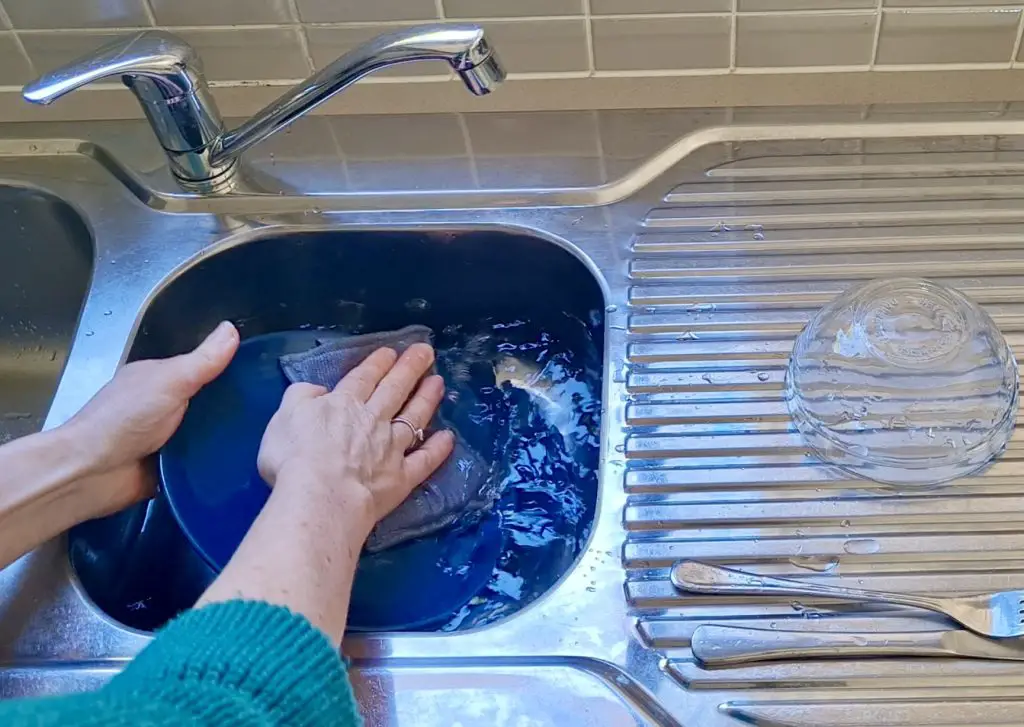
One of the biggest questions people ask is:
“Is handwashing dishes cheaper than using a dishwasher?“
In our home, yes, I feel that handwashing is far cheaper than using the dishwasher.
By switching to handwashing, we eliminated:
- Dishwasher tablets or powder
- Rinse aids
- Dishwasher cleaning products
- Occasional machine maintenance expenses
Now, all we use:
🫧 Basic dishwashing liquid (Earth Choice – around $2.50)
🫧 Norwex scrub cloths (reusable – been using the same pair for years!)
That’s it.
While it’s true that modern dishwashers can be water-efficient, cost isn’t only about water usage. It’s also about product consumption, replacement parts, and the hidden cost of owning more dishes to support the system.
For a small household like ours, handwashing has reduced household expenses and simplified the routine.
| 🌿 READ: My 10 Fave Norwex Products → |
The Hidden Costs of Using a Dishwasher
When you wonder whether a dishwasher is cheaper than handwashing, electricity is just the tip of the iceberg.
Here are the ongoing costs per wash cycle in Australia:
- Electricity – Around $0.25–$0.50 per cycle (depending on your tariff and eco vs standard setting).
- Water – Roughly $0.05–$0.10 per cycle (most modern dishwashers use 9–12 litres).
- Dishwasher tablets or pods – Typically $0.25–$0.45 per wash, depending on brand and whether you buy in bulk.
- Rinse aid – Around $0.03–$0.07 per cycle.
- Dishwasher salt (for hard water areas) – Roughly $0.02–$0.05 per wash.
- Appliance wear and tear – Spreading the cost of a $400–$700 dishwasher over 8–10 years works out to roughly $0.15–$0.25 per day if used daily.
So even though a single cycle may not feel expensive, the true cost includes water, electricity, consumables, and long-term appliance depreciation.
These add up over the year — making handwashing with just $2 dishwashing liquid a surprisingly cost-effective alternative.
Handwashing Dishes: Pros and Cons
Let’s be honest, we all have that one household chore that we loathe (for me, it’s cleaning the oven!). So, I can understand if handwashing dishes is that chore for you. In which case, all pros might be outweighed by that single con.
Handwashing Pros
Many of the PROS for handwashing:
- Immediate reset — wash, dry, done
- No waiting for a full load
- Lower product costs
- Greater control over cleanliness
- Encourages fewer dishes
- Supports minimalist kitchen habits
Switching back to handwashing has felt surprisingly grounding for me. In fact, I find doing the dishes meditative and relaxing. Maybe it’s got something to do with keeping my hands busy while allowing my mind to wander.
Plus, there’s something psychologically satisfying about washing a dish and knowing it’s clean right now.
I🌿 It removes the delay.
🌿 It removes the uncertainty of “Will I just have to deep-clean them later anyway?”
🌿 It removes the “I’ll deal with it later” pile-up.
Handwashing Cons
To be realistic, there are some negatives to handwashing, so let’s address them.
The CONS for handwashing:
- It requires daily consistency
- It’s less convenient after large meals
- It takes hands-on time
- It can take multiple loads per day to stay on top of things
For larger families, dishwasher use may absolutely be more practical.
But for our lifestyle, handwashing supports simplicity better.
How Switching to Handwashing Helped Me Declutter the Kitchen

This is where the shift became bigger than dishes.
When I decided to commit to handwashing, I pulled everything out of the cupboards.
Plates. Bowls. Mugs. Glassware.
And I realised we didn’t need most of it.
Because when you handwash dishes:
- You reuse items more quickly
- You don’t need large rotations
- You notice what you actually use
- You stop storing “just in case” duplicates
We kept:
- Four mugs we genuinely love
- My favourite teacup
- A few meaningful glasses
- A small practical set of tumblers
- Plenty of plates & bowls (but I can definitely downsize)
Everything else was decluttered.
The dishwasher had quietly justified owning excess.
Removing the system exposed the surplus.
This is minimalism in the kitchen in action — simplifying systems first, then simplifying possessions.
| 🌿 READ: Decluttering When Overwhelmed → |
A Small Kitchen Reset That Made a Big Difference

While everything was out, I wiped down cupboards and drawers.
🌿 It wasn’t a dramatic renovation.
🌿 It was a partial kitchen reset.
But it this simple reset created:
- Clearer cabinets
- More breathing room
- Less visual clutter
- A simpler daily routine
If you’re wondering how to simplify your kitchen, start with systems — not stuff.
When decluttering areas of the kitchen, ask yourself:
- “Is this appliance reducing friction or creating it?”
- “Does this system require more inventory than necessary?”
- “Is this habit aligned with how we actually live?”
Often, decluttering kitchen cabinets becomes easier when the underlying system changes first.
The Bigger Lesson: Simplify the System, Not Just the Stuff
This wasn’t really about dishwasher vs handwashing. It was about removing friction.
There was one small thing in my home quietly draining energy every few months. Instead of managing it better, I removed it entirely.
That decision led to:
- Lower household expenses
- Fewer dishes
- Less cupboard clutter
- A cleaner-feeling kitchen
- A lighter mental load
If you feel overwhelmed in your home, don’t start by decluttering everything. Start by fixing the system that’s bothering you most.
Simplify the system, and the decluttering will often follow naturally.
Will I Keep Handwashing Instead of Using a Dishwasher?
At this stage, I’m about 3 months into handwashing instead of filling up the dishwasher. In all honesty, I haven’t even had one moment of wistfully yearning for my dishwasher days.
Handwashing to me feels:
- More intentional
- More cost-effective
- More aligned with minimalist living
- More satisfying day-to-day
For our household size (3 people) and habits, it works. And if that means pairing back our kitchen even further, I’m open to that, too.
Because sometimes modern convenience isn’t the simplest option… It’s simply doing it yourself.
Pin It